

Credit Card vs. Crypto Payments: What Merchants Should Know

Choosing the right payment method can impact your business’s profitability and customer satisfaction. Here’s a quick breakdown:
- Credit cards are widely accepted, offer fraud protection, and support chargebacks, but come with higher fees (1.5%–3.5%) and chargeback risks.
- Cryptocurrency provides lower fees (0.5%–1%), faster settlements, and no chargebacks but involves price volatility, regulatory uncertainty, and technical challenges.
For high-risk industries like e-commerce, CBD, or online gaming, combining both options can reduce risks, improve cash flow, and cater to a broader customer base.
Why Companies Like JP Morgan And Visa Are Creating Crypto Tokens

Credit Card Payments: Benefits and Drawbacks
For many high-risk merchants, credit cards are a crucial part of their operations. However, understanding how they work and the trade-offs involved is essential.
How Credit Card Processing Works
Every credit card transaction follows a multi-step process. It begins when a customer uses their card, and the terminal sends the transaction details to a payment processor. The processor then routes this information through a card network – like Visa or Mastercard – to the issuing bank for authorization.
The issuing bank checks the account for available credit and scans for potential fraud before approving or declining the transaction. If approved, the transaction progresses to the clearing phase, where bundles of transactions are processed through the card networks. Finally, during settlement, the funds are transferred from the customer’s bank to the merchant’s account. High-risk merchants often add extra layers of security during this process to protect against fraud.
This seamless process lays the foundation for several benefits that credit card payments bring to merchants.
Credit Card Payment Benefits
Credit cards provide merchants with several advantages, particularly for those operating in high-risk sectors. Their widespread acceptance, real-time fraud detection, and buyer protections build customer confidence, which can lead to higher sales and conversion rates.
Fraud detection systems work behind the scenes, monitoring transactions in real time to flag unusual activity. Additionally, many high-risk payment processors offer merchants some breathing room when it comes to chargebacks. Instead of immediately shutting down accounts, they often collaborate with merchants to resolve disputes.
Credit card processing also opens doors to global markets. With multi-currency support, merchants can accept international payments and easily convert them into their preferred currency. High-risk processors often accommodate businesses with fluctuating or high transaction volumes by providing more flexible volume limits.
Credit Card Payment Challenges
Despite their advantages, credit cards come with challenges, especially for high-risk merchants. One of the biggest hurdles is the higher fees associated with high-risk accounts, which can cut into profits. Frequent chargebacks – common in high-risk industries – not only result in lost revenue but also add extra costs. The dispute process, which often favors consumers, can turn even legitimate transactions into drawn-out and expensive headaches.
Regulatory compliance is another significant burden. High-risk merchants face stricter regulations, which can drive up operational costs. Account stability is also a concern, as payment processors may freeze or terminate accounts based on automated risk assessments. On top of that, high-risk accounts often experience longer processing delays and reserve holds, which can disrupt cash flow and create additional financial strain.
Cryptocurrency Payments: Benefits and Drawbacks
Cryptocurrency payments are gaining popularity, especially among businesses in high-risk sectors, offering a digital alternative to traditional payment methods. While crypto payments can serve as an effective substitute for credit cards, they come with their own set of pros and cons that merchants need to weigh carefully.
How Crypto Payments Work
Cryptocurrency transactions operate on blockchain networks – decentralized systems that record every transaction transparently and securely. When a customer makes a crypto payment, they transfer funds from their digital wallet to the merchant’s wallet address. The transaction is then broadcast to the blockchain, where miners or validators confirm its legitimacy before adding it to the ledger.
Unlike credit card payments, crypto transactions skip intermediaries like banks or card networks. This direct process allows payments to settle in minutes rather than days. Many payment processors also offer instant conversion to stablecoins, such as USDC, enabling merchants to receive funds in a currency tied to the U.S. dollar. While this streamlined setup offers clear benefits, it also introduces specific challenges.
Cryptocurrency Payment Benefits
For merchants, particularly those in high-risk industries, cryptocurrency payments come with several advantages:
- Lower transaction fees: Crypto payments typically cost 0.5%–1% per transaction, compared to the 1.5%–3.5% fees associated with credit cards.
- No chargebacks: Once a transaction is confirmed on the blockchain, it’s irreversible, shielding businesses from fraudulent chargeback claims – a common issue in traditional payment systems.
- Global reach: Merchants can accept payments from customers worldwide without dealing with international banking hurdles or currency conversion fees.
- Growing user base: The number of crypto users is projected to surpass 861 million by 2025, presenting a growing market of consumers who value privacy and digital payment options.
- Stablecoins for reliability: Stablecoins offer fast, low-cost transactions while maintaining a consistent value, reducing concerns about price fluctuations.
Cryptocurrency Payment Challenges
Despite these perks, crypto payments come with notable challenges that merchants need to address:
- Price volatility: Cryptocurrency values can fluctuate dramatically, making it difficult for businesses to predict cash flow.
- Security risks: Digital wallets are vulnerable to hacks, and stolen or misdirected funds can be nearly impossible to recover.
"Anonymity is no longer the big selling point of these digital currencies anymore", says Eswar Prasad, Economics Professor at Cornell University and author of The Future of Money: How the Digital Revolution is Transforming Currencies and Finance.
- Regulatory uncertainty: The legal landscape for crypto in the U.S. is still evolving, with businesses required to comply with strict Know Your Customer (KYC) and Anti-Money Laundering (AML) regulations.
"Regulation for crypto assets has been under consideration for some time, but there was a heightened sense of urgency after a series of bank collapses that were tied to crypto asset activities", notes the World Economic Forum.
- Tax complications: The IRS treats cryptocurrency as property, meaning merchants must report payments as gross income based on the fair market value at the time of receipt. This creates additional administrative work and requires meticulous record-keeping.
- Technical hurdles: Implementing crypto payments demands secure wallet integrations, blockchain management, and staff training. High transaction volumes can also strain some blockchain networks, leading to delays.
- Limited adoption: While the crypto user base is growing, many consumers remain hesitant due to concerns about security, volatility, and the complexity of managing digital wallets.
Cryptocurrency payments present a mix of opportunities and obstacles. While they offer lower fees, global accessibility, and protection from chargebacks, they also require businesses to navigate regulatory uncertainty, technical challenges, and consumer skepticism. For merchants, understanding these trade-offs is key to deciding whether crypto payments align with their business goals.
sbb-itb-16c71f6
Credit Card vs. Crypto Payments Comparison
When deciding between credit card and cryptocurrency payment options, merchants need to weigh factors that impact both profitability and the customer experience. Each method offers distinct advantages and challenges, which are especially important for high-risk businesses with specific operational needs.
Key Considerations
For high-risk merchants, transaction fees play a big role in determining profit margins, while settlement speed affects how quickly funds become available. Chargeback risk is another major issue, as disputes can result in lost revenue and penalties. Additionally, fraud prevention measures vary between these payment methods, influencing how well they protect against unauthorized transactions. Finally, regulatory compliance requirements differ, with traditional and digital payment systems operating under separate legal frameworks.
Other factors to consider include customer adoption, global accessibility, transaction reversibility, technical requirements, and the potential for price volatility.
Side-by-Side Comparison Table
| Factor | Credit Cards | Cryptocurrency |
|---|---|---|
| Transaction Fees | 1.5%–3.5% per transaction | 0.5%–1% per transaction |
| Settlement Time | 2–3 business days | Minutes to hours |
| Chargeback Risk | High | None (transactions are irreversible) |
| Fraud Protection | Comprehensive fraud monitoring | Limited; transactions are final |
| Customer Adoption | Widely accepted | Growing but still limited |
| Geographic Reach | Global with some restrictions | Borderless with minimal barriers |
| Regulatory Compliance | Well-established frameworks | Evolving regulations, KYC/AML required |
| Technical Complexity | Standard integration | Requires blockchain knowledge |
| Price Volatility | Stable (pegged to fiat currency) | High volatility (except stablecoins) |
| Transaction Reversibility | Reversible through disputes | Irreversible once confirmed |
| Processing Reliability | Proven and reliable systems | Can face delays due to network congestion |
| Tax Implications | Straightforward reporting | Complex, property-based tax rules |
This table highlights the trade-offs between credit cards and cryptocurrency, helping merchants choose the best fit for their business needs.
Credit cards stand out for their widespread acceptance and robust fraud protection, making them a reliable choice for businesses focused on customer convenience and security. However, their higher fees and susceptibility to chargebacks can cut into profits, particularly for high-risk industries. On the other hand, cryptocurrency payments offer lower fees and eliminate chargeback risks, but they require customers to be familiar with digital wallets and blockchain technology.
For high-risk merchants, crypto payments can improve profit margins due to lower fees, especially for high-volume transactions. However, implementing crypto payment systems often involves more complex infrastructure and staff training compared to traditional credit card setups.
Lastly, while credit card processing benefits from well-established legal frameworks, cryptocurrency payments face a dynamic regulatory environment. This evolving landscape can create compliance challenges but also offers opportunities for businesses that adopt strong KYC and AML practices early on.
Using RiskPay for Credit Card and Crypto Payments
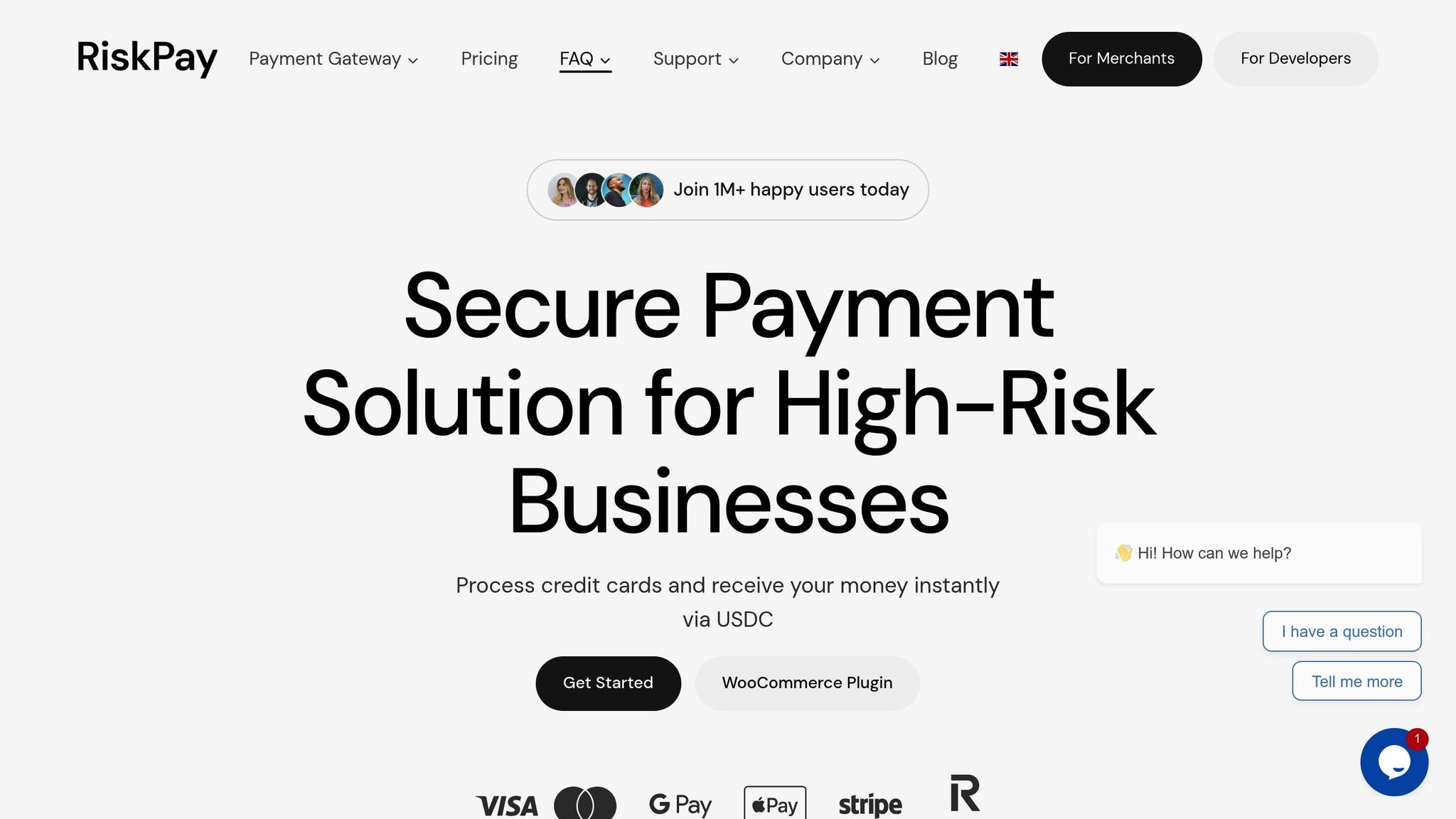
RiskPay streamlines payment processing for high-risk merchants by combining credit card and cryptocurrency transactions into one seamless solution. Instead of managing multiple payment providers, merchants can handle both payment methods through a single integration. This approach simplifies operations and addresses the unique challenges faced by businesses in high-risk industries.
RiskPay Payment Integration Features
RiskPay offers a blend of instant USDC payouts alongside traditional payment options like credit cards, Apple Pay, and Google Pay. This integration not only provides faster settlements but also ensures merchants can maintain the broad appeal of conventional payment methods while benefiting from competitive fees.
For e-commerce businesses, RiskPay’s WooCommerce integration makes setup straightforward. The dedicated WordPress plugin connects directly to existing online stores, eliminating the need for complex custom development. Additionally, RiskPay enables anonymous payment link generation without requiring merchant KYC verification. However, customers may need to complete a quick 2-minute ID verification depending on the payment provider, using their mobile camera.
RiskPay also adheres to PCI DSS compliance standards, ensuring all credit card transactions meet the highest levels of security. These features make implementation smooth, as detailed in the following section.
How to Integrate RiskPay
To get started, merchants can download the WooCommerce plugin from the WordPress repository, where it currently boasts a 5-star rating. After installation, configuring the plugin settings integrates RiskPay into your payment workflow. The platform automatically routes transactions between traditional card processing and cryptocurrency settlements, depending on your preferences.
Fraud protection tools are activated as soon as RiskPay is integrated. With USDC payouts being final and irreversible, merchants are protected from chargeback disputes. For traditional payments, licensed providers handle any potential issues. Technical support is also readily available. Once the system is live, merchants benefit from improved cash flow and reduced exposure to chargebacks.
RiskPay Benefits for Merchants
RiskPay’s unified payment approach enhances operational efficiency and cash flow management. Merchants gain from prompt USDC settlements, which improve liquidity compared to standard credit card processing times. With global payment acceptance, businesses can expand their reach across borders with fewer restrictions.
The platform also simplifies regulatory compliance by blocking domains associated with prohibited business categories, reducing the administrative workload for merchants.
For high-volume merchants, the combination of reduced chargeback risks and cost-effective transaction fees translates into significant savings and improved profitability. By integrating RiskPay, businesses can optimize their payment processing while minimizing operational headaches.
Choosing the Right Payment Strategy
Finding the best payment mix for your business requires a careful look at your business model, customer preferences, and how much risk you’re comfortable taking. This builds on earlier comparisons of fees, settlement speeds, and potential risks.
Key Points for High-Risk Merchants
High-risk merchants have unique needs when it comes to payment strategies. For example, cryptocurrency can be appealing due to its lower transaction fees and irreversible payments, which help reduce chargeback issues often associated with credit cards. Younger customers are increasingly open to using cryptocurrency, while more traditional customers still prefer credit cards.
When it comes to cash flow, the speed of settlements matters. Credit card payments typically take a few business days to process, while cryptocurrency payments are almost instantaneous. For businesses that need quick access to funds, this faster turnaround can be a game-changer.
Regulatory compliance also varies depending on the payment method. Credit card processing requires meeting PCI DSS standards, while cryptocurrency transactions may involve different regulations depending on your location and industry.
Next Steps and Recommendations
Start by understanding your customer base. What do they value most – speed, privacy, or familiarity? This insight will help you tailor your payment strategy to their preferences.
Next, assess your business’s risk profile. If chargebacks or regulatory hurdles are a concern, adding cryptocurrency as a payment option could help reduce costs and improve efficiency. Compare your current processing fees with the potential savings from using alternative payment methods.
A hybrid approach might be the best way forward. By offering both credit cards and cryptocurrency, you can cater to a broader audience while taking advantage of the strengths of each payment type. For instance, platforms like RiskPay make this easier by handling both credit card and USDC transactions in one system, simplifying your operations.
When introducing new payment methods, start small. Add cryptocurrency payments alongside your existing credit card options and monitor how your customers respond. This gradual rollout minimizes disruptions to your current setup.
Finally, choose payment solutions that are easy to integrate. Overly complicated systems can lead to headaches during implementation. Tools like RiskPay’s WooCommerce plugin make it simple to add multiple payment options without heavy development work.
FAQs
What should high-risk merchants consider when accepting both credit card and cryptocurrency payments?
High-risk merchants have much to gain by offering both credit card and cryptocurrency payment options, but each comes with its own set of pros and cons. Credit cards are a familiar choice for most customers, offering broad acceptance and built-in consumer protections. Features like chargebacks can safeguard buyers, though they might create complications for merchants by increasing financial risks.
Cryptocurrency payments bring a different set of benefits. They typically come with lower transaction fees, appeal to tech-savvy customers, and enable quicker cross-border transactions. However, challenges like price volatility and shifting regulatory landscapes can add complexity for businesses.
To strike the right balance between these payment methods, merchants need to consider their customer demographics, the specific demands of their industry, and their overall risk tolerance. Using tools to manage chargebacks and prevent fraud, while keeping up with the latest cryptocurrency regulations, can help ensure a seamless payment process for everyone involved.
How can merchants address regulatory and security challenges when accepting cryptocurrency payments?
To navigate the challenges of regulation and security in cryptocurrency payments, businesses need to take deliberate steps to safeguard their operations and customers. Begin by adopting robust security practices like two-factor authentication and advanced transaction monitoring. These measures can help protect against fraud and prevent unauthorized access.
Additionally, compliance with Know-Your-Customer (KYC) and anti-money laundering (AML) regulations is crucial. This means verifying customer identities and keeping accurate records. Staying updated on changing cryptocurrency laws and working with trusted payment processors can further minimize risks and ensure your business remains compliant.
How does RiskPay improve payment processing for businesses in high-risk industries?
RiskPay makes payment processing easier for businesses in high-risk industries by offering solutions designed to tackle common issues like fraud, chargebacks, and secure transaction management. With RiskPay, merchants gain access to tools that help minimize risks and simplify payment acceptance, creating a more seamless operational experience.
On top of that, RiskPay supports both traditional credit card payments and cryptocurrency transactions. This flexibility allows businesses to meet the varied preferences of their customers while maintaining strong security measures and staying compliant with industry standards.
Related Blog Posts
- Emerging Payment Trends Every High-Risk Business Needs to Watch in 2026
- High-Risk Merchant Account 101: Your Essential Guide to Payments and Penalties
- The Hidden Cost of Doing Business: Deconstructing High-Risk Merchant Fees
- Stop Guessing: The Clear Difference Between High-Risk vs. Low-Risk Processing